PhpProbe is a PHP library allowing to simply probe/monitor any applications and services, and either print results or use them in code.
Also, PhpProbe respects PSR-0/1/2 and PSR-3, meaning (among others) it can be used with any PSR-3 compliant logger (see setLogger() on Probes) like Monolog.
Note that this library (especially because it's only a library) is not intended to be used instead of monitoring tools like Nagios, which already do the job.
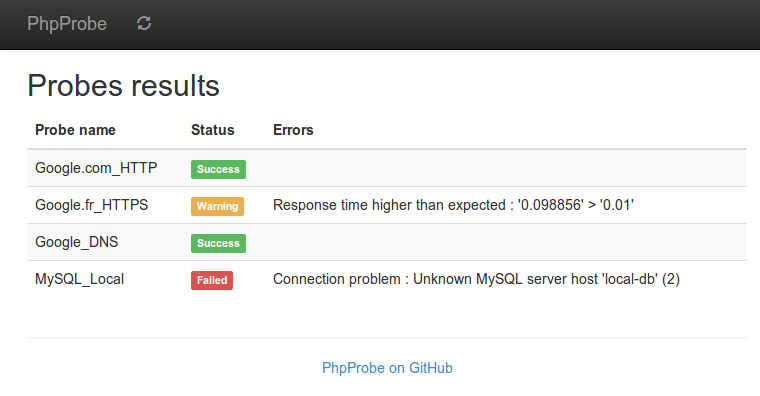
Here's an example what you can simply do with PhpProbe and a few lines of code (see php-probe-webapp for sources):
A Probe (eg. Tcp, Http, Database) relies on a (compatible) Adapter (eg. Netcat, PhpCurl, PhpMysql), which will return an AdapterResponse, possibly containing data to test/check.
At this point a Probe is considered successful if it could run successfuly (eq. TCP connection established).
You can also add one or more Check to check for specific conditions (eg. response time below a given value, HTTP response code ...).
Any PSR-3 compliant logger can also be attached to a Probe,(as Monolog), to be warned any error happening, by email for example. Monolog is shipped with several handlers that will certainly fit your needs. Each Check can have a defined log level, and therefore be handled by specific handlers.
There are 2 ways this library can be used:
<?php
require __DIR__ . "/../vendor/autoload.php";

error_reporting(E_ERROR | E_RECOVERABLE_ERROR);

/* TCP Probe */
$tcpProbe = new PhpProbe\Probe\TcpProbe('Google_DNS', array(), new \PhpProbe\Adapter\NetcatAdapter());
$tcpProbe->host('8.8.8.8')->port(53);

/* HTTPS Probe */
$checkerHttps = new PhpProbe\Check\HttpCheck();
$checkerHttps
    ->addCriterion('httpCode', \PhpProbe\Http\Codes::HTTP_NOT_FOUND)
    ->addCriterion('content', 'G[o]+ggle');

$logger = new \Monolog\Logger('PhpProbe');

$httpsProbe = new PhpProbe\Probe\HttpProbe('Google_HTTPS', array(), new \PhpProbe\Adapter\PhpCurlAdapter());
$httpsProbe
    ->url('https://www.google.com/')
    ->addChecker($checkerHttps)
    ->setLogger($logger);

$manager = new PhpProbe\Manager();
$manager
    ->addProbe($tcpProbe)
    ->addProbe($httpsProbe)
    ->checkAll();
See examples/standalone.php
Calling $manager->output(true) will print results (including success) that will look like this:
# Google_DNS - Success
# Google_HTTPS - Failure (Expected value '404' for 'httpCode', got '302' - Expected content 'G[o]+ggle' not found in response.)
$webservice = new PhpProbe\Probe\HttpProbe(
    'GitHub_HTTPS',
    array(),
    new \PhpProbe\Adapter\PhpCurlAdapter()
);

$webservice->url('https://api.github.com/repos/michael-bouvy/php-probe');

$httpChecker = new \PhpProbe\Check\HttpCheck();
$httpChecker->addCriterion('httpCode', \PhpProbe\Http\Codes::HTTP_FORBIDDEN);
$webservice->addChecker($httpChecker);

$webservice->check();

if ($webservice->hasSucceeded()) {
    // Do something cool
}
See examples/framework.php
No matter which way you use this library, you can load the probes from a YAML config file, like this example:
probes:
  Google.com_HTTP:
    type: Http
    options:
      url: http://www.google.com
      timeout: 5
    checkers:
      http:
        httpCode: 302
  Google.fr_HTTPS:
    type: Http
    options:
      url: https://www.google.fr
      timeout: 5
    checkers:
      http:
        httpCode: 200
        content: <title>Goorrgle</title>
      generic:
        responseTime: 1
  Google_DNS:
    type: Tcp
    adapter: Netcat
    options:
      host: 8.8.8.8
      port: 53
    checkers:
      generic:
        responseTime: 0.5
  MySQL_Local:
    type: Database
    options:
      host: localhost
      user: root
      password:
    checkers:
      database:
        database: [test, mysql]
See examples/config.yml
Then simply load the config file in your code:
$manager = new PhpProbe\Manager();
$manager->importConfig('my_config.yml');
$manager->checkAll();
See examples/standalone_config.php
Probes rely on adapters: for instance TcpProbe can either work with PHP's fsockopen() function, or locally installed Unix utility netcat.
-
TcpProbeFsockopenAdapter(uses PHP'sfsockopen()function)NetcatAdapter(usesnetcatutility)- Probe options:
host: hostname or IP without protocol (eg.1.2.3.4)port: self-explanatorytimeout: request timeout in seconds
-
HttpProbe: check for HTTP response code or response contentPhpCurlAdapter(uses PHP's curl extension)- Probe options:
url: URL to check, including protocol (eg.http://www.mysite.com/mypage.php)timeout: request timeout in secondsheaders: an array of HTTP headers to send (eg.['Cache-control: no-cache', 'Cookie: key=value'])
-
DatabaseProbe: check for database connection or existing databasePhpMysqlAdapter(uses PHP's mysql extension)- Probe options:
host: hostname or IP without protocol (eg.1.2.3.4)database: database name (not used byPhpMysqlAdapter(see checker below), will be necessary for future PostgreSQL adapter)user: usernamepassword: password, may be emptytimeout: connection timeout, not used yetquery: SQL query to execute (must include database) for query result check (only first column of first row is used)
-
TestProbe: for testing purposesTestAdapter
A NullAdapter is also available, always succeeding.
These probes can be used with one or more of the following checkers:
HttpCheck:httpCode: self-explanatorycontent: check for a given value in the response content (also works with regular expressions ; case insensitive)
DatabaseCheck:database: check for one (or multiple) existing database(s) for connected userquery: expected query result
GenericCheck:responseTime: check if probe's response time is below the given value
TestCheck: for testing purposes
composer require php-probe/php-probe
Or manually, add the PhpProbe library to your composer.json:
{
    "require": {
        "php-probe/php-probe": "dev-master"
    }
}Clone the repository in your project:
$ git clone https://github.com/michael-bouvy/php-probeYou can use the provided autoloader:
require __DIR__ . "/src/PhpProbe/Autoloader.php";
\PhpProbe\Autoloader::register();
If you already use a custom (non PSR-0 compliant) autoloader, you might want to prepend PhpProbe's autoloader to autoloaders stack. Simply pass true as argument to the register() method:
\PhpProbe\Autoloader::register(true);Special thanks to Julien CHICHIGNOUD (@juchi) for his Checkers concept and implementation.
To run the test suite, you need composer.
$ php composer.phar install --dev
$ vendor/bin/phpunitPhpProbe is licensed under the MIT license.