I am reading the source code of Libevent, so this simple server is extrated from the wisdom of Libevent epoll design. And none Libevent API is used, so this simple server is built from scratch.
Things need to think about in this simple server:
- For listening socket, this options needs to think about:
SOCK_NONBLOCK,SOCK_CLOEXEC(No need, since I don't usefork, so there is no leak),SO_KEEPALIVE(funny, I'll do some research),SO_REUSEADDR(do more deep research on this, even though I know it is for not hanging on listening socket when restart),SO_REUSEPORT(do more deep research, this one is funny in linux),TCP_DEFER_ACCEPT(this one is useful, but I just forget ...) - everything is automated, everything is event based, things happen, callback functions are called. Event based design is natural, if I want to write a scalable server, the first thing is to abstract all things to events and hide the deep implementation of polling loop.
epoll_createis a legacy? Should we always useepoll_create1?timerfd_createcan be used to create a timer event, funny, I think it won't be used.accept4andaccept
Details after research:
SO_KEEPALIVEin listening socket:- TCP Keepalive HOWTO
- according to man-page of
man 2 accept, it seems that the descriptor flags inheritence is not reliable. so I won't useSO_KEEPALIVEin thebindsocket. and this option should be configurable by user. so this simple server example won't useSO_KEEPALIVEoption.
SO_REUSEADDRandSO_REUSEPORT:- Socket options SO_REUSEADDR and SO_REUSEPORT, how do they differ? Do they mean the same across all major operating systems?
- in linux man page
SO_REUSEADDR: Indicates that the rules used in validating addresses supplied in a bind(2) call should allow reuse of local addresses. For AF_INET sockets this means that a socket may bind, except when there is an active listening socket bound to the address. When the listening socket is bound to INADDR_ANY with a specific port then it is not possible to bind to this port for any local address. Argument is an integer boolean flag.SO_REUSEPORT: Permits multiple AF_INET or AF_INET6 sockets to be bound to an identical socket address. This option must be set on each socket (including the first socket) prior to calling bind(2) on the socket. To prevent port hijacking, all of the processes binding to the same address must have the same effective UID. This option can be employed with both TCP and UDP sockets. For TCP sockets, this option allows accept(2) load distribution in a multi-threaded server to be improved by using a distinct listener socket for each thread. This provides improved load distribution as compared to traditional techniques such using a single accept(2)ing thread that distributes connections, or having multiple threads that compete to accept(2) from the same socket. For UDP sockets, the use of this option can provide better distribution of incoming datagrams to multiple processes (or threads) as compared to the traditional tech‐nique of having multiple processes compete to receive datagrams on the same socket.- so I won't use
SO_REUSEPORT, I think there is no bottle-neck inaccpet. for each physical connection, even if you have multiple threads accept on differenct sockets which useSO_REUSEPORT, if packet is distributed to every socket with duplicates, then it is bad design, you need make sure each packet is processed once. or if packet is add to one socket with no duplicates, then it is no need to useSO_REUSEPORT, since the ready queue for each physical connection shared by all sockets in this connection.
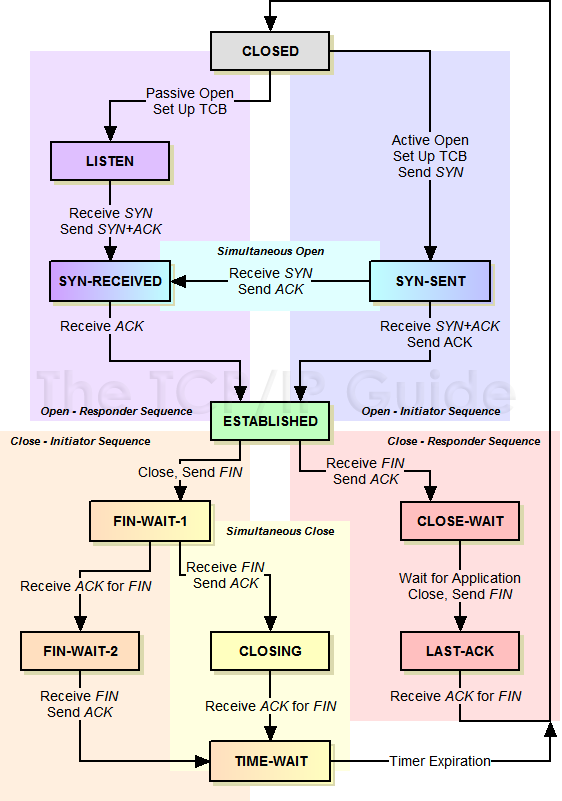
- at this point I am going to talk about
TIME_WAIT, I didn't understand it rightly before:- the TCP State Machine
-
- so
TIME_WAITstatus is for the end which doclosefirst, and to make sure the peer end receive the last ack. if the last ack is lost,closeend will close connection afterlingertime. andFINfrom peer end will retransmit after timeout happened. sincecloseend has already close the connection. so aRSTis sent back, connection is closed for peer end. - but I have a question? if let server close connection first, there must be too many connection in
TIME_WAITstatus, if let client close connection first, there might be too many active connections in server side if client doesn't close connection. I think I should always let clientcloseconnection first, and there is a timeout in server side, HEHE, digging back toLibeventsource code.Libevent's implementation is checking elapsed time for all events everytime.
TCP_CORK: gather packet frame, send by one time like scatter/gather io. can be used withTCP_NODELAY, but no need to use this option in this little example.TCP_DEFER_ACCEPT: it is good to set this option, because in real world we don't want to be waken up if tcp connection has just established. useTCP_DEFER_ACCEPTmeans that wake me up when data comes.TCP_NODELAY: set this option to disable Nagel Algorithm:- Nagel Algorithm
- I think Nagel Algorithm should be disabled in my simple server, because it is multithreading, I can't ensure the order is always
read-write-read-write, it is normal that awrite-write-readhappens.
TCP_QUICKACK: since we have setTCP_NODELAY, there is no need to setTCP_QUICKACK, just use default delayed ack to improve network performance.epoll_createis just legacy, no much difference withepoll_create1- no much difference between
acceptandaccept4,accept4is convenient for setO_NONBLOCKINGfor connected socket. - for
EPOLLONESHOT, there is no need for use this option if wereaduntilEAGAINevery time.
- compile server with
g++ server.cpp threadpool.c -o server -lpthread - compile client with
g++ client.cpp threadpool.c -o client -lpthread - full version please see Charles-Server