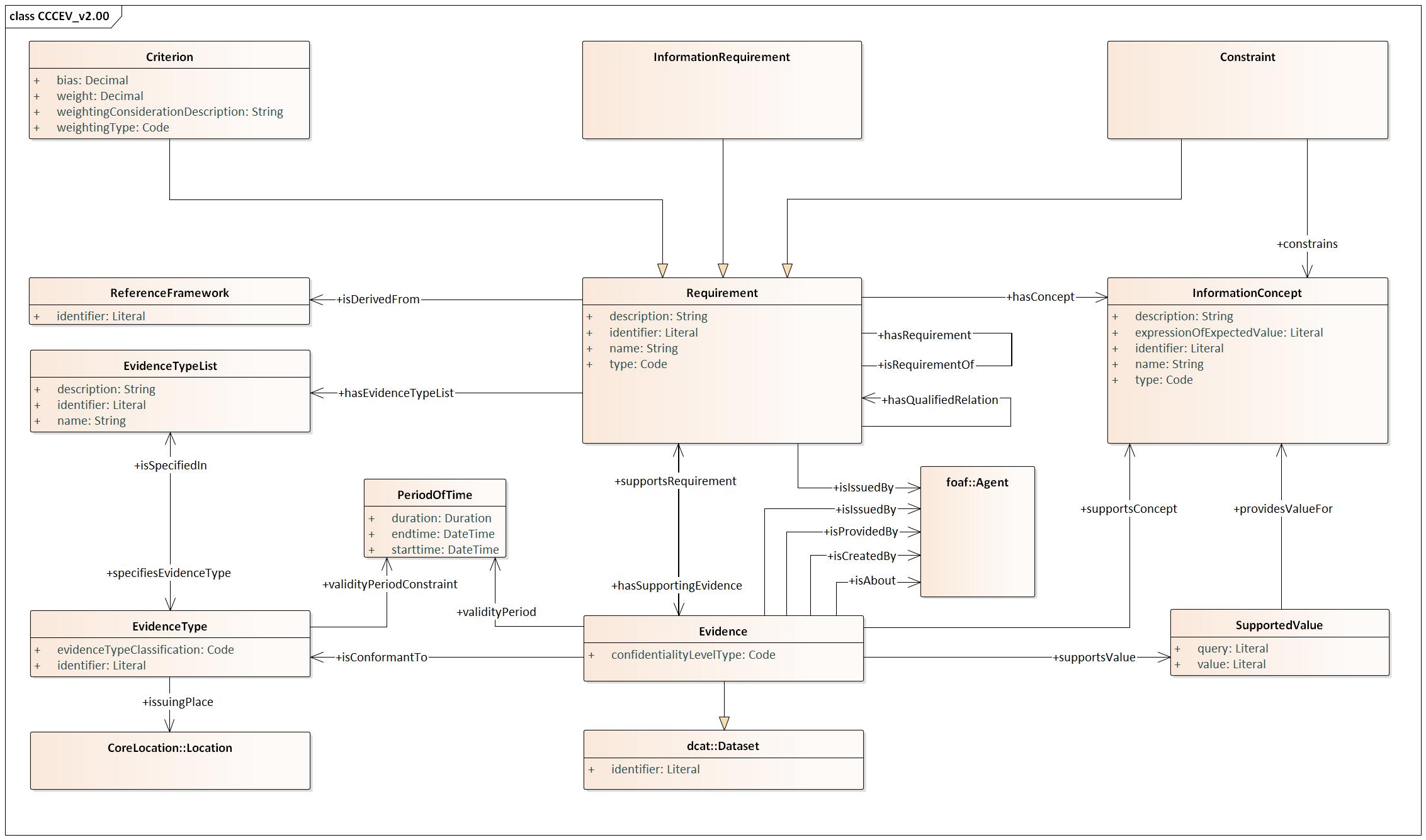
The connect-cccev project facilitates managing certification processes. It allows defining complex Requirements based on the standard CCCEV vocabulary, including associated InformationConcepts (specific data points) and needed Evidence (proofs). The system uses a Neo4j graph database to store these interconnected elements and provides an F2 API to create certifications and track their fulfillment by adding evidence and value
CCCEV gives us three main building blocks:
- Requirement: This is the rule, the question, or the condition that needs to be met or checked.
- Analogy: A question in a form ("Are you over 18?") or a task in a checklist ("Provide proof of address").
- Example (Youth Pass): "Applicant must be under 26 years old."
- CCCEV Definition: "A condition or prerequisite that is to be proven by Evidence." Requirements can be simple checks (
InformationRequirement), evaluation criteria (Criterion), or specific limitations (Constraint). For now, just think of it as the rule.
- InformationConcept: This is the specific piece of information that a
Requirementneeds, or that anEvidenceprovides.
- Analogy: The specific blank field on a form ("Date of Birth", "City Name", "Annual Income").
- Example (Youth Pass): To check the "Under 26" requirement, we need the "Date of Birth". "Date of Birth" is the
InformationConcept. - CCCEV Definition: "Piece of information that the Evidence provides or the Requirement needs."
- DataUnit: Every
InformationConcepthas a specific type of data, called aDataUnit. This tells us if the information is a date, a number, text, true/false, etc. * Example (Youth Pass): TheInformationConcept"Date of Birth" has aDataUnitof "Date". AnInformationConceptlike "Age" would have aDataUnitof "Number". * CCCEV Reference: Although not a direct CCCEV class, it aligns with theInformationConcept.typeand expected value format. Inconnect-cccev,DataUnitprovides this structure.
- Evidence: This is the actual proof or answer provided to satisfy a
Requirement.
- Analogy: The document you upload (ID scan, certificate PDF) or the answer you type into a form.
- Example (Youth Pass): A scan of your national ID card or passport is the
Evidence. This document contains the "Date of Birth" (InformationConcept) needed to verify the "Under 26" (Requirement). - CCCEV Definition: "Proof that a Requirement is met."

Each InformationConcept has its own score. The total score of a request is the average score of all its InformationConcepts.
Computation rules per field
- Score value goes from 0 to 100 included
- A field with an auto-computed value does not have a score
- Having no value blocks the score to 0, no matter if some other conditions are verified
- Having a value gives +50 score
- The rest is computed according to the provided evidences for the field (from 0 to 50 included)
- Each EvidenceTypeList has its own score
- The final score corresponds to the highest amongst the EvidenceTypeLists
- The score of an ETL is
(numberOfFulfilledEvidenceTypes / totalEvidenceTypes) * 50