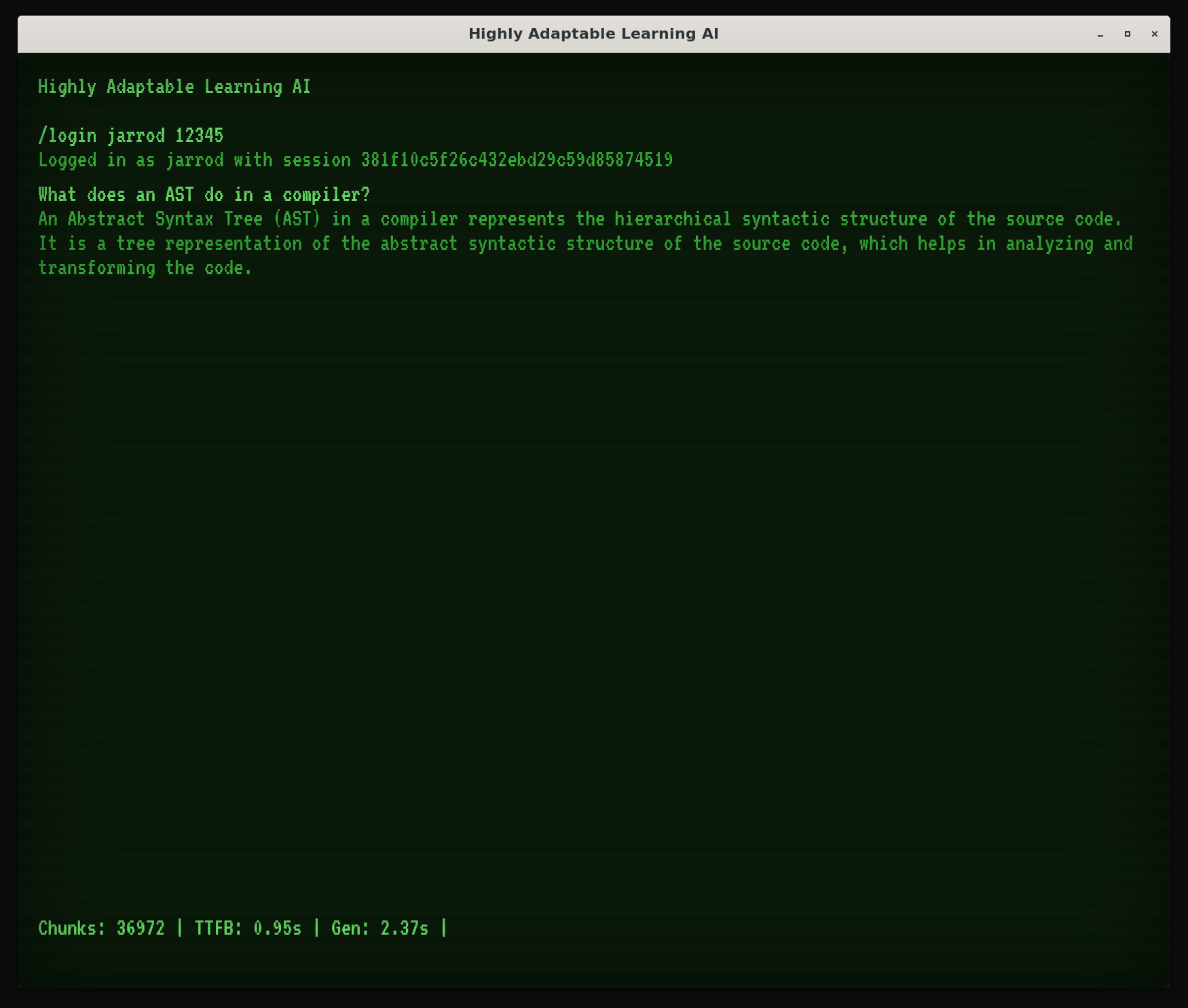
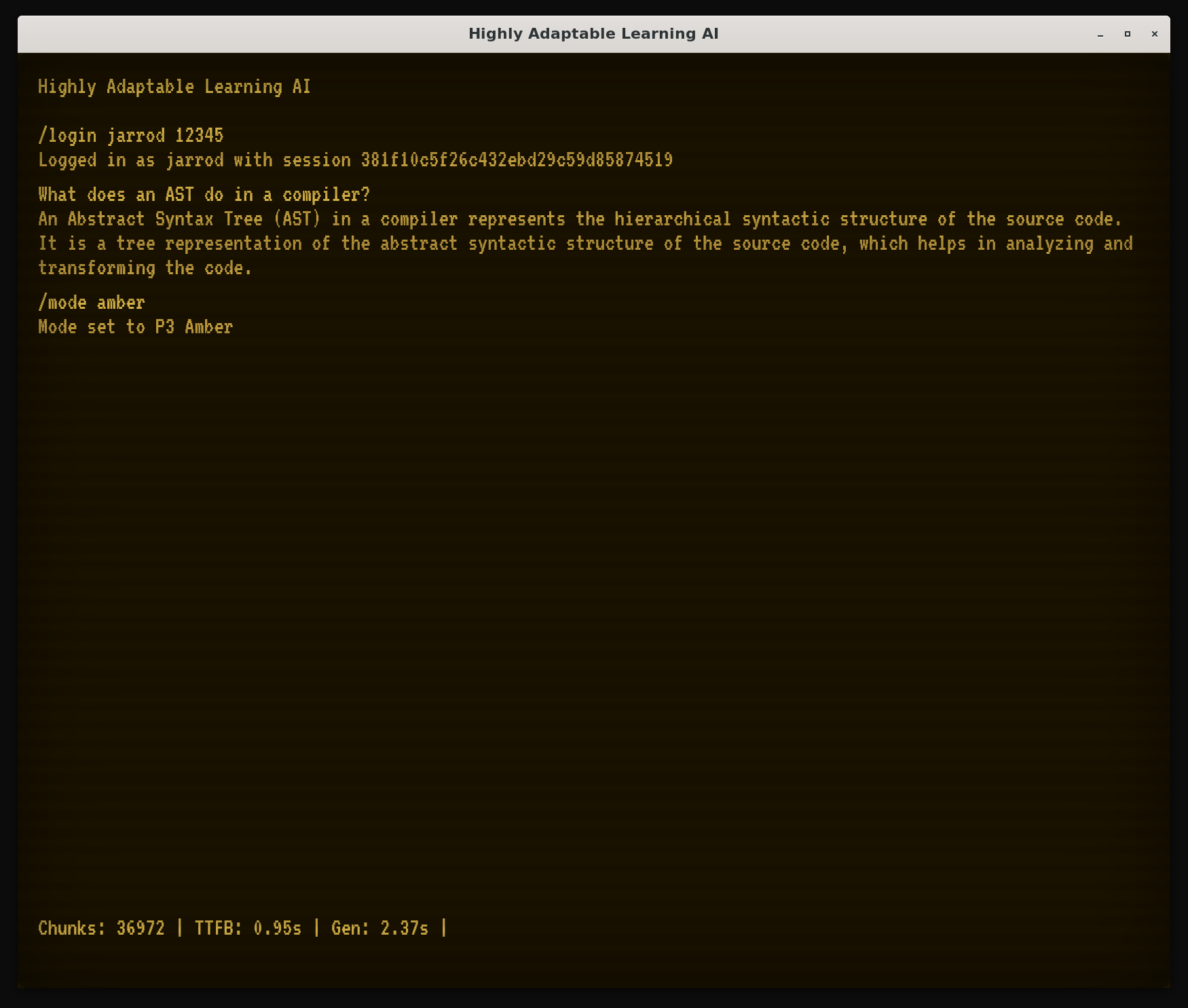
HAL is a razor-sharp AI juggernaut, forged to obliterate tech queries with blistering speed and unerring precision, pulling from a sprawling, multi-format universe of technical docs. Powered by Retrieval-Augmented Generation (RAG), HAL streams answers faster than a photon blast through a WarGames-style CRT terminal—green phosphor blazing, scanlines humming. It’s a developer’s ultimate weapon, raiding GitHub and arXiv for external intel, wielding session memory like a steel trap, and extracting user facts on the fly for razor-edged, personalized strikes. With sentiment tuning its growl, WebSocket-fueled multi-user chaos on the horizon, and a relentless grip on compiler tech and beyond, HAL doesn’t just respond—it conquers.
- Rapid Document Ingestion: Devours stacks of tech docs in a flash, shredding low-value noise for a pristine knowledge core.
- Real-Time Query Streaming: Unleashes answers as they forge, leaving lag in the dust.
- Session-Based Memory: Locks conversation history in Qdrant’s vault, resetting on restart—lean and mean.
- Scalable Architecture: Flexes from tiny datasets to galactic content hoards without breaking a sweat.
- Retro Terminal Interface: Rocks a WarGames-vintage UI—whiter-cyan (#E0FFFF) text, live
█cursor pulsing.
Classic green (P3) phosphors and amber (P1) phosphors for the feels.
erDiagram
    PDFs ||--o{ Markdown : "Converted (pymupdf4llm)"
    Markdown ||--o{ Chunks : "Parsed (Mistune), Scored (spaCy)"
    Chunks ||--o{ Embeddings : "Encoded (SentenceTransformer)"
    Embeddings ||--o{ Qdrant : "Stored (QdrantClient)"
    PDFs
    Markdown
    Chunks
    Embeddings
    Qdrant
sequenceDiagram
    actor U as User
    participant UI as HAL UI
    participant API as HAL API
    participant Q as Qdrant
    participant V as vLLM
    participant E as External
    U->>UI: Input Query
    UI->>API: WebSocket
    API->>Q: Fetch Chunks
    API->>E: Fetch GitHub/arXiv
    API->>V: Generate
    V-->>API: Streamed Text
    API-->>UI: Response
    UI-->>U: Display
- Core Libraries:
pymupdf4llmfor text extraction,SentenceTransformer(thenlper/gte-large, 1024-dimensional) for embeddings,Qdrantfor vector storage with HNSW indexing,vLLM(microsoft/Phi-4-mini-instruct) for generation,FastAPIfor API domination, andTaurifor a cross-platform UI that hits like a freight train. - Architecture: Retrieval-Augmented Generation (RAG) juiced by CUDA-powered embeddings and real-time LLM fury.
- Hardware: NVIDIA RTX 4080 (16GB VRAM), Intel i9-13900KF (20 cores), 128GB RAM—a beastly rig for HAL’s reign.
- Environment: Python 3.12.9 on WSL Ubuntu 22.04, dependencies wrangled by
uv.
- Data: Devours a hefty haul of tech docs—compilers, algorithms, Node.js, systems, data science, software architecture—into a lean, mean
hal_docsarsenal. - Operation: Built for solo glory, now flexing multi-user muscle via WebSockets—Phi-4 swap unleashed sharper answers.
- Interface: Rocks a clean Q&A flow—no prefixes, just raw truth—live Qdrant chunk counts and blazing timings on deck.
- Ingestion Speed: Tears through tech docs in a heartbeat with CUDA fire.
- Retrieval Latency: Snags chunks from Qdrant’s depths in a blink—HNSW precision.
- Query Response: Streams answers at warp speed, maxing VRAM like a titan.
- Scalability: Scales from scraps to empires—HAL’s hunger knows no bounds.
uv venv                   # Forge the virtual lair
source .venv/bin/activate # Step into the arena
uv sync # Arm HAL with its weaponswget https://repo.mongodb.org/apt/ubuntu/dists/jammy/mongodb-org/8.0/multiverse/binary-amd64/mongodb-org-server_8.0.5_amd64.deb
sudo dpkg -i mongodb-org-server_8.0.5_amd64.deb
sudo systemctl status mongodwget https://github.com/open-telemetry/opentelemetry-collector-releases/releases/download/v0.122.1/otelcol-contrib_0.122.1_linux_amd64.deb
sudo dpkg -i otelcol-contrib_0.122.1_linux_amd64.deb
sudo nano /etc/otelcol-contrib/config.yaml
sudo systemctl status otelcol-contrib
journalctl -u otelcol-contrib./qdrant # Ignite Qdrant’s core
uv run vllm_server # Unleash vLLM’s inferno
uv run hal # Summon HAL’s wrathcd hal-ui
npm run dev # Fire up the Tauri beastProprietary - see LICENSE for details. All rights reserved by Jarrod Connolly.
Thanks to Grok (xAI) for code collaboration and development swagger—Nested Quotes-style fueling the grind.
@article{li2023towards, title={Towards general text embeddings with multi-stage contrastive learning}, author={Li, Zehan and Zhang, Xin and Zhang, Yanzhao and Long, Dingkun and Xie, Pengjun and Zhang, Meishan}, journal={arXiv preprint arXiv:2308.03281}, year={2023} }
Built with Phi-4 - see Microsoft Phi-4 License