
A progressive Node.js framework for building efficient and scalable server-side applications.







Nest framework TypeScript starter repository.
$ npm install# development
$ npm run start
# watch mode
$ npm run start:dev
# production mode
$ npm run start:prodNest is an MIT-licensed open source project. It can grow thanks to the sponsors and support by the amazing backers. If you'd like to join them, please read more here.
- Author - Kamil Myśliwiec
- Website - https://nestjs.com
- Twitter - @nestframework
Nest is MIT licensed.
This is an Expo project created with create-expo-app.
-
Install dependencies
npm install
-
Start the app
npx expo start
In the output, you'll find options to open the app in a
- development build
- Android emulator
- iOS simulator
- Expo Go, a limited sandbox for trying out app development with Expo
You can start developing by editing the files inside the app directory. This project uses file-based routing.
When you're ready, run:
npm run reset-projectThis command will move the starter code to the app-example directory and create a blank app directory where you can start developing.
To learn more about developing your project with Expo, look at the following resources:
- Expo documentation: Learn fundamentals, or go into advanced topics with our guides.
- Learn Expo tutorial: Follow a step-by-step tutorial where you'll create a project that runs on Android, iOS, and the web.
Join our community of developers creating universal apps.
- Expo on GitHub: View our open source platform and contribute.
- Discord community: Chat with Expo users and ask questions.

This GitHub repository contains a posture detection program that utilizes YOLOv5, an advanced object detection algorithm, to detect and predict lateral sitting postures. The program is designed to analyze the user's sitting posture in real-time and provide feedback on whether the posture is good or bad based on predefined criteria. The goal of this project is to promote healthy sitting habits and prevent potential health issues associated with poor posture.
Key Features:
- YOLOv5: The program leverages the power of YOLOv5, which is an object detection algorithm, to accurately detect the user's sitting posture from a webcam.
- Real-time Posture Detection: The program provides real-time feedback on the user's sitting posture, making it suitable for use in applications such as office ergonomics, fitness, and health monitoring.
- Good vs. Bad Posture Classification: The program uses a pre-trained model to classify the detected posture as good or bad, enabling users to improve their posture and prevent potential health issues associated with poor sitting habits.
- Open-source: The program is released under an open-source license, allowing users to access the source code, modify it, and contribute to the project.

- Python 3.9.x
If you have an NVIDIA graphics processor, you can activate GPU acceleration by installing the GPU requirements. Note that without GPU acceleration, the inference will run on the CPU, which can be very slow.
git clone https://github.com/itakurah/SittingPostureDetection.gitpython -m venv venv.\venv\scripts\activate.bat
pip install -r ./requirements_windows.txtORpip install -r ./requirements_windows_gpu.txt
git clone https://github.com/itakurah/SittingPostureDetection.gitpython3 -m venv venvsource venv/bin/activate
pip3 install -r requirements_linux.txtORpip3 install -r requirements_linux_gpu.txt
python application.py <optional: model_file.pt> OR python3 application.py <optional: model_file.pt>
The default model is loaded if no model file is specified.
The program uses a custom trained YOLOv5s model that is trained on about 160 images per class for 146 epochs. The model has two classes: sitting_good and sitting_bad to give feedback about the current sitting posture.
The architecture that is used for the model is the standard YOLOv5 architecture:

Fig. 1: The architecture of the YOLOv5 model, which consists of three parts: (i) Backbone: CSPDarknet, (ii) Neck: PANet, and (iii) Head: YOLO Layer. The data are initially input to CSPDarknet for feature extraction and subsequently fed to PANet for feature fusion. Lastly, the YOLO Layer outputs the object detection results (i.e., class, score, location, size)
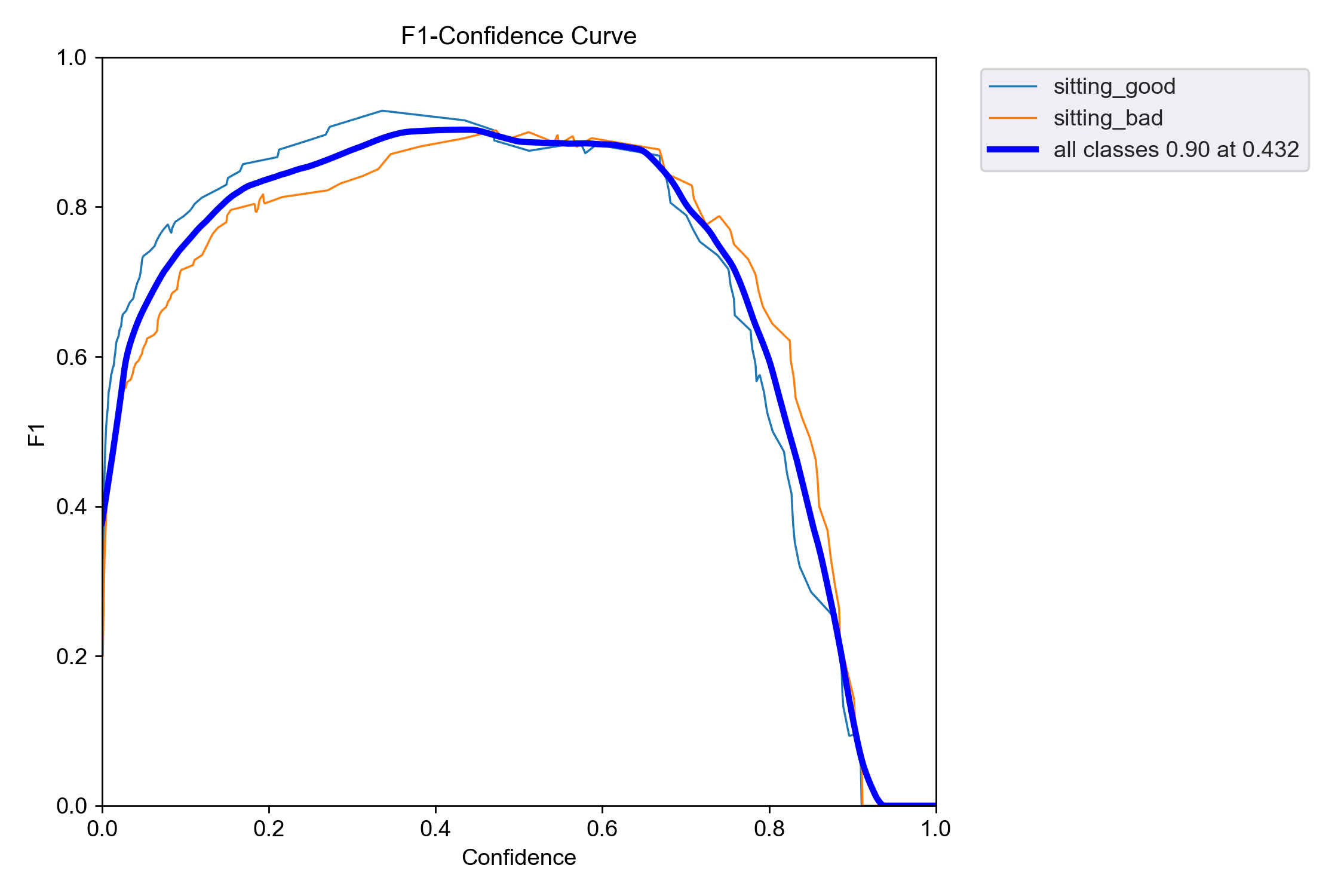
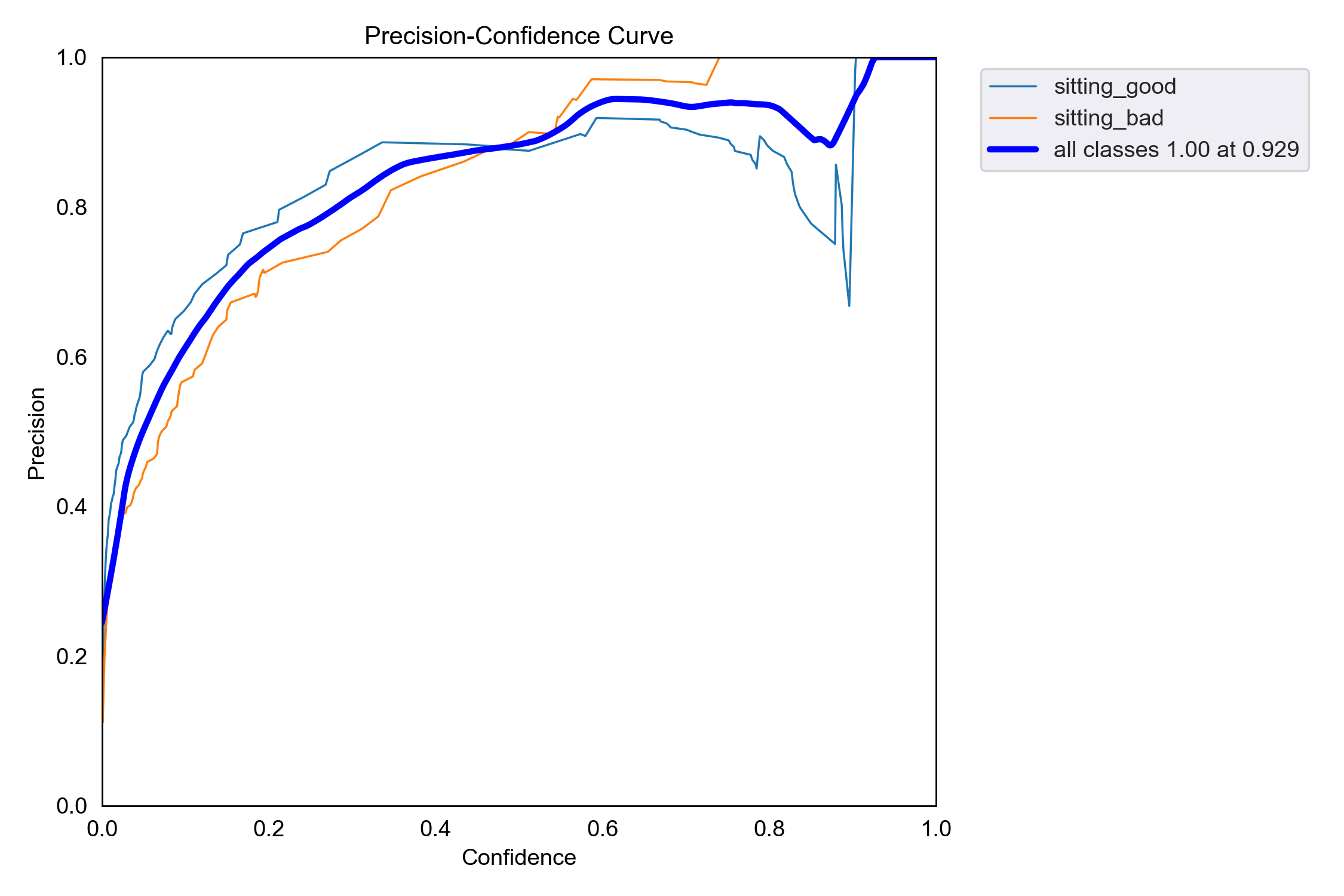
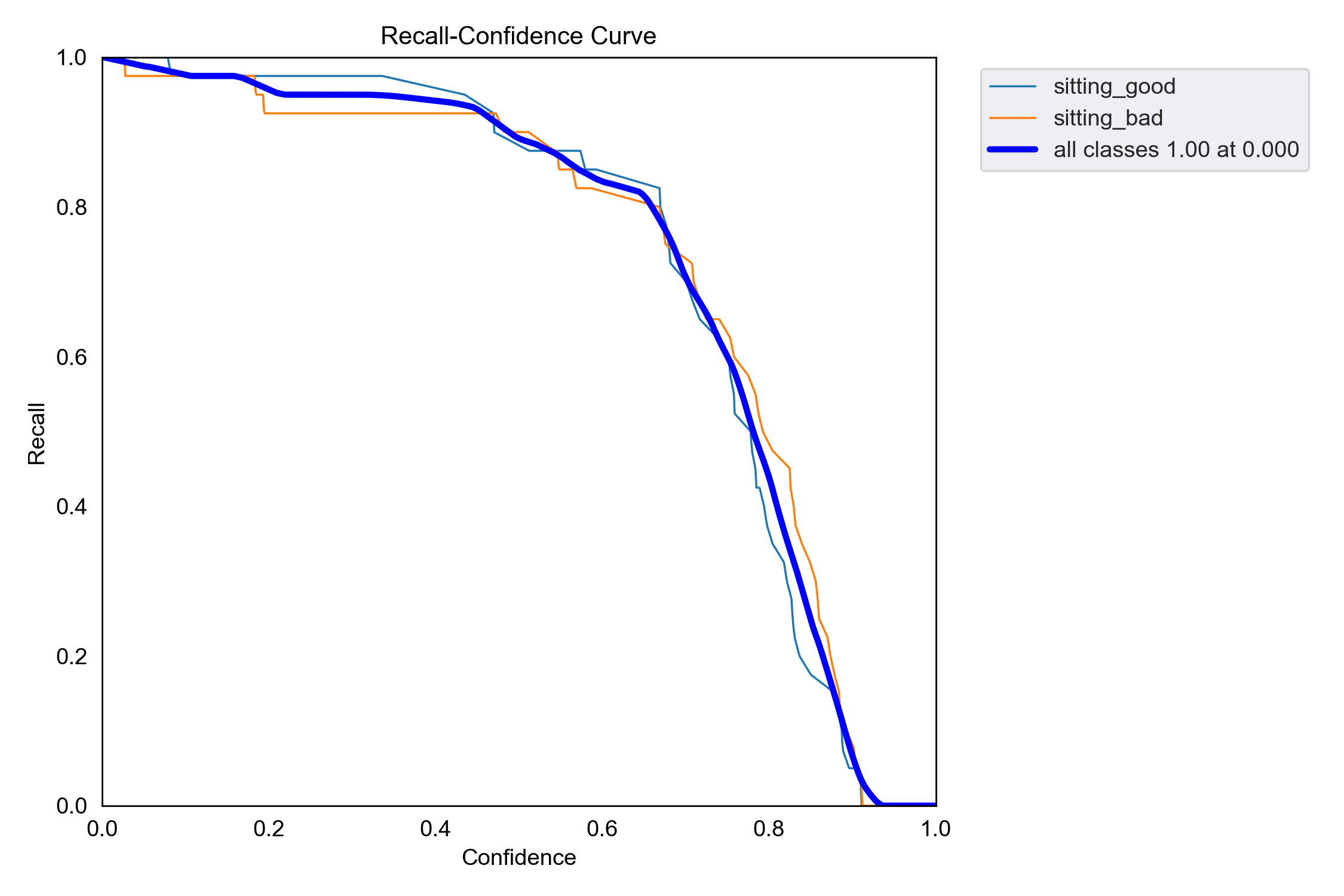
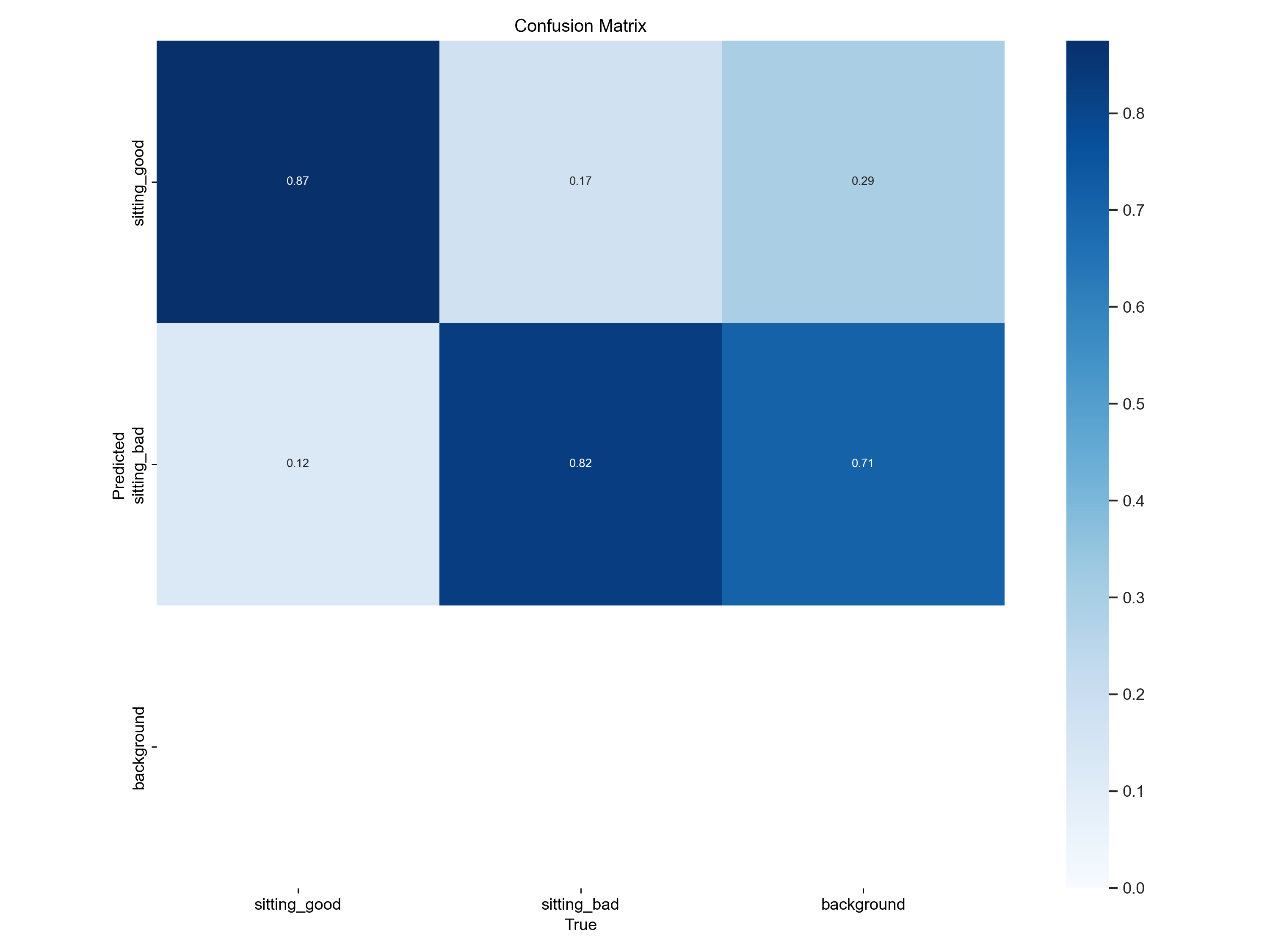
The validation set contains 80 images (40 sitting_good, 40 sitting_bad). The results are as follows:
| Class | Images | Instances | Precision | Recall | mAP50 | mAP50-95 |
|---|---|---|---|---|---|---|
| all | 80 | 80 | 0.87 | 0.939 | 0.931 | 0.734 |
| sitting_good | 40 | 40 | 0.884 | 0.954 | 0.908 | 0.744 |
| sitting_bad | 80 | 40 | 0.855 | 0.925 | 0.953 | 0.724 |
Detailed graphs:
F1-Confidence Curve:
Precision-Confidence Curve:
Recall-Confidence Curve:
Precision-Recall Curve:

Confusion Matrix:
This project was developed by Niklas Hoefflin, Tim Spulak, Pascal Gerber & Jan Bösch and supervised by André Jeworutzki and Jan Schwarzer as part of the Train Like A Machine module.
- Jocher, G. (2020). YOLOv5 by Ultralytics (Version 7.0) [Computer software]. https://doi.org/10.5281/zenodo.3908559
- Fig. 1: TraCon: A novel dataset for real-time traffic cones detection using deep learning - Scientific Figure on ResearchGate. Available from: https://www.researchgate.net/figure/The-architecture-of-the-YOLOv5-model-which-consists-of-three-parts-i-Backbone_fig1_360834230 [accessed 24 Jun, 2023]
This project is licensed under the MIT License. See the LICENSE file for details.