We forked Stanley Huang's ArduinoOBD repository from https://github.com/stanleyhuangyc/ArduinoOBD
This is code to work on the Freematics devices. We have the Mega Kit with Bluno Mega 2560 Arduino board:
- https://freematics.com/store/index.php?route=product/product&path=24&product_id=58
- https://freematics.com/pages/products/arduino-telematics-kit-3/
- https://freematics.com/pages/products/arduino-telematics-kit-3/developers-guide/
In our local copy of the ArduinoOBD repository, we only kept the "megaloggerHD" application (which runs on our Mega Kit) and the "libraries" files. For compiling the Arduino megaloggerHD application, the subfolders under libraries should be copied to your "%userprofile%\Documents\Arduino\libraries" folder (for example, C:\Users\johnw\Documents\Arduino\libraries).
One issue for us to addresss in this code is that the data output format from the Arduino is the "Data Logging" format shown at the bottom of https://freematics.com/pages/products/arduino-telematics-kit-3/developers-guide/. In this format, each PID/data channel is on its own line of output. It would be good to transition from this to a real CSV output that we could use for processing with CloudTurbine.
The Bluno Mega 2560 board is made by DFRobot (https://wiki.dfrobot.com/Bluno_Mega_2560__SKU_DFR0323_). Android code for communicating with the Bluetooth connection on this Bluno Mega 2560 board is described at https://wiki.dfrobot.com/Bluno_SKU_DFR0267#Bluno_Basic_Demo. We have a modified version of this code in our BlunoBasicDemo repository (https://github.com/DigiLog-N/BlunoBasicDemo).
The rest of the notes here are from Stanley's original README file.
(C)2012-2018 Freematics.com
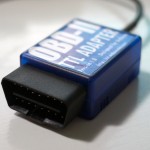
OBD-II Adapter for Arduino is a product that works as a vehicle OBD-II data bridge for Arduino (literally all embedded platforms) with open-source Arduino library provided. Besides providing easy-to-use OBD-II data access, it also integrates 9-DOF motion sensor and voltmeter for measuring vehicle battery power. The adapter draws power from OBD-II port and convert it to 5V for powering attached device.
Related Products
Most commonly use PIDs are defined in OBD library as followings.
Engine
PID_RPM – Engine RPM (rpm)
PID_ENGINE_LOAD – Calculated engine load (%)
PID_COOLANT_TEMP – Engine coolant temperature (°C)
PID_ENGINE_LOAD – Calculated Engine load (%)
PID_ABSOLUTE_ENGINE_LOAD – Absolute Engine load (%)
PID_TIMING_ADVANCE – Ignition timing advance (°)
PID_ENGINE_OIL_TEMP – Engine oil temperature (°C)
PID_ENGINE_TORQUE_PERCENTAGE – Engine torque percentage (%)
PID_ENGINE_REF_TORQUE – Engine reference torque (Nm)
Intake/Exhaust
PID_INTAKE_TEMP – Intake temperature (°C)
PID_INTAKE_PRESSURE – Intake manifold absolute pressure (kPa)
PID_MAF_FLOW – MAF flow pressure (grams/s)
PID_BAROMETRIC – Barometric pressure (kPa)
Speed/Time
PID_SPEED – Vehicle speed (km/h)
PID_RUNTIME – Engine running time (second)
PID_DISTANCE – Vehicle running distance (km)
Driver
PID_THROTTLE – Throttle position (%)
PID_AMBIENT_TEMP – Ambient temperature (°C)
Electric Systems
PID_CONTROL_MODULE_VOLTAGE – vehicle control module voltage (V)
PID_HYBRID_BATTERY_PERCENTAGE – Hybrid battery pack remaining life (%)
Additional defines can be added to access other OBD-II PIDs.
libraries - all Arduino libraries needed for OBD-II adapter and kits
samples - several simple sketches for testing purpose
nanologger - OBD-II data logger working with 128x64 monochrome OLED display (for Arduino Nano)
megalogger - OBD-II and GPS data logger based on 320x240 TFT LCD display (for Arduino MEGA)
megaloggerHD - OBD-II and GPS data logger based on 480x320 TFT LCD display (for Arduino MEGA)
tester - a testing sketch for OBD-II communication and capability
utilites - useful utility source code for development