
From Wikipedia: Bubble sort, sometimes referred to as sinking sort, is a simple sorting algorithm that repeatedly steps through the list to be sorted, compares each pair of adjacent items and swaps them if they are in the wrong order. The pass through the list is repeated until no swaps are needed, which indicates that the list is sorted.
Properties
- Worst case performance O(n^2)
- Best case performance O(n)
- Average case performance O(n^2)
View the algorithm in action

From Wikipedia: Insertion sort is a simple sorting algorithm that builds the final sorted array (or list) one item at a time. It is much less efficient on large lists than more advanced algorithms such as quicksort, heapsort, or merge sort.
Properties
- Worst case performance O(n^2)
- Best case performance O(n)
- Average case performance O(n^2)
View the algorithm in action
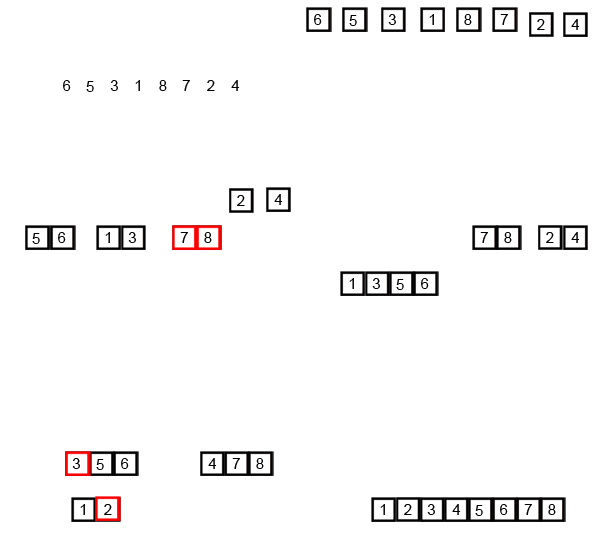
From Wikipedia: In computer science, merge sort (also commonly spelled mergesort) is an efficient, general-purpose, comparison-based sorting algorithm. Most implementations produce a stable sort, which means that the implementation preserves the input order of equal elements in the sorted output. Mergesort is a divide and conquer algorithm that was invented by John von Neumann in 1945.
Properties
- Worst case performance O(n log n)
- Best case performance O(n)
- Average case performance O(n)
View the algorithm in action

From Wikipedia: Quicksort (sometimes called partition-exchange sort) is an efficient sorting algorithm, serving as a systematic method for placing the elements of an array in order.
Properties
- Worst case performance O(n^2)
- Best case performance O(n log n) or O(n) with three-way partition
- Average case performance O(n^2)
View the algorithm in action

From Wikipedia: The algorithm divides the input list into two parts: the sublist of items already sorted, which is built up from left to right at the front (left) of the list, and the sublist of items remaining to be sorted that occupy the rest of the list. Initially, the sorted sublist is empty and the unsorted sublist is the entire input list. The algorithm proceeds by finding the smallest (or largest, depending on sorting order) element in the unsorted sublist, exchanging (swapping) it with the leftmost unsorted element (putting it in sorted order), and moving the sublist boundaries one element to the right.
Properties
- Worst case performance O(n^2)
- Best case performance O(n^2)
- Average case performance O(n^2)
View the algorithm in action

From Wikipedia: Shellsort is a generalization of insertion sort that allows the exchange of items that are far apart. The idea is to arrange the list of elements so that, starting anywherem considereing every nth element gives a sorted list. Such a list is said to be h-sorted. Equivanelty, it can be thought of as h intterleaved lists, each individually sorted.
Properties
- Worst case performance O(nlog2 2n)
- Best case performance O(n log n)
- Average case performance depends on gap sequence
View the algorithm in action
###Time-Compexity Graphs
Comparing the complexity of sorting algorithms (Bubble Sort, Insertion Sort, Selection Sort)
###TimSort


From Wikipedia: Timsort is a hybrid stable sorting algorithm, derived from merge sort and insertion sort, designed to perform well on many kinds of real-world data. It was implemented by Tim Peters in 2002 for use in the Python programming language. The algorithm finds subsequences of the data that are already ordered, and uses that knowledge to sort the remainder more efficiently. This is done by merging an identified subsequence, called a run, with existing runs until certain criteria are fulfilled.
On small lists of random elements, Timsort looks just like mergesort. The image above was generated with the type of data that Timsort really shines on - a partially ordered array. This lets us see behaviours like run detection and the bulk reversal of chunks of reverse-sorted data.
Properties
- Worst case performance O(nlogn)
- Best-case performance O(n^2)
- Average performance O(nlogn)